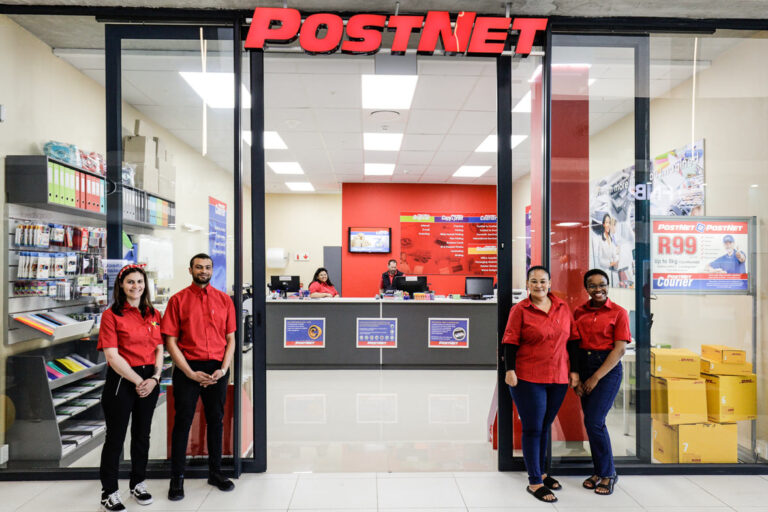
PostNet Kokstad Rolyats provides various business solutions, including printing, courier services, stationery products, and digital solutions. – Postnet Copy & Read more...
Sorry, no records were found. Please adjust your search criteria and try again.
Sorry, unable to load the Maps API.
South Africa boasts a robust and dynamic courier industry, catering to both businesses and individual customers.
The sector offers a diverse range of services from same-day express delivery, and overnight shipping, to international logistics solutions. Courier companies in the country operate with an emphasis on speed, reliability, and security, offering door-to-door delivery services that are essential in today’s fast-paced commercial environment.
Their offerings also include value-added services such as package tracking, proof of delivery, and insurance.
South African courier services are equipped to handle a wide range of goods, from small parcels to bulky goods, leveraging an extensive network of road, air, and sometimes rail routes. With the advent of e-commerce, these companies have also adapted to meet the rising demand for efficient parcel delivery and return services, contributing significantly to the country’s digital economy.
As South Africa’s economy continues to grow and diversify, the courier industry stands as a vital pillar supporting both commerce and personal communication in the nation.
In 2026, Kokstad continues to punch above its weight as the economic engine of East Griqualand. Its strategic location on the N2 highway makes it a critical logistics and retail node for a vast hinterland that includes parts of the Eastern Cape and southern KwaZulu-Natal. The economy is traditionally anchored by agriculture (dairy, beef, and sheep) and a robust retail sector that draws consumers from as far as Matatiele and Mount Frere.
For 2026, the focus has shifted toward agro-logistics and manufacturing. Under the 2025/2026 KZN Economic Development Plan, the municipality is prioritizing the revitalization of local industrial parks to support small-scale black industrialists. However, the agricultural sector has faced significant pressure in early 2026 due to the national Foot-and-Mouth Disease (FMD) crisis. This led to the rescheduling of major regional events, including the Royal Agricultural Show, which was moved to October 2026 to allow disease-control measures to stabilize. For investors, the "Greater Kokstad 2026 Growth Strategy" emphasizes the town's role as a secondary city, focusing on high-growth sectors like renewable energy and IT-enabled services to diversify away from its purely pastoral roots.
Tourism in Kokstad is a unique blend of high-altitude natural beauty and the profound history of the Griqua people.
Key highlights for 2026 include:
Mount Currie Nature Reserve: Located just 5 km from the town, this reserve remains a premier 2026 destination for birdwatching (over 220 species) and hiking. It also houses the Adam Kok III Memorial and the historic Laager site.
Harry Gwala District Municipality Marathon: Held in March 2026, this race has become a significant qualifier for the Comrades Marathon, drawing thousands of athletes and boosting the local hospitality sector.
East Griqualand Museum: Often called the Kokstad Museum, it offers an immersive look into the Griqua trek and the founding of the town. In 2026, it serves as a critical heritage node for researchers studying South African frontier history.
Crystal Dam: A popular 2026 spot for bass fishing and family picnics, situated within the Mount Currie reserve.
St. Patrick’s Cathedral: A landmark of early 20th-century architecture that remains a focal point for the town's diverse religious community.
The history of Kokstad is the story of the Griqua nation's search for independence. In the 1860s, Adam Kok III led approximately 2,000 Griquas on a perilous two-year trek across the Drakensberg from Philippolis in the Free State to what became known as Griqualand East.
The town was formally founded in 1872 and named "Kok’s Town" in honor of their leader. For a brief period, the Griquas maintained a measure of independence, even issuing their own currency, before the territory was annexed by the British Cape Colony in 1874. Adam Kok III died in a tragic carriage accident near the town in 1875. In 2026, Kokstad remains a symbol of this unique mixed-descent heritage, with many residents still proudly identifying with the Griqua lineage and its 19th-century struggle for land and recognition.
Under the Greater Kokstad Local Municipality’s 2025/2026 Integrated Development Plan (IDP), the town is addressing a mix of rapid urban growth and aging utility networks.
Key infrastructure highlights for 2026 include:
Horseshoe Sanitation Project: In April 2026, the R137 million sanitation project—intended to replace pit latrines with flushing toilets in the Horseshoe area—was reported as technically complete. However, the project has faced significant hurdles, with reports of broken pipes and water supply issues due to vandalism and a lack of maintenance.
Mahhagu Sanitation Project: A further R14 million has been allocated in the 2026 budget to address the 11 remaining structures and repair the pump stations that have stalled the Horseshoe project's full functionality.
N2 Corridor Upgrades: Ongoing maintenance by SANRAL in early 2026 focuses on the arterial links passing through Kokstad, ensuring that the heavy-vehicle freight corridor remains viable for the logistics sector.
Smart Utility Management: The 2026 budget includes a pilot program for prepaid smart meters to improve revenue collection and manage the rising costs of electricity and water, which have seen double-digit increases in the 2026/27 financial cycle.