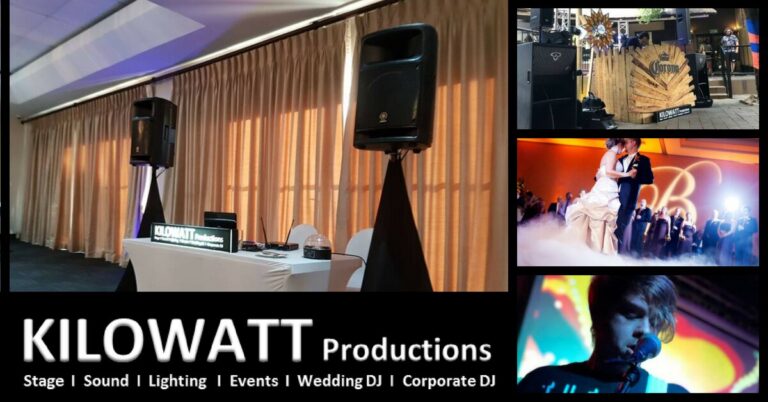
Are you looking for a Wedding DJ in Pretoria? We cater for Hundreds of Functions in Pretoria. Kilowatt Productions – Read more...
Sorry, no records were found. Please adjust your search criteria and try again.
Sorry, unable to load the Maps API.
South Africa’s DJ landscape is a vibrant reflection of the country’s cultural rhythm, offering a rich mix of sound, energy, and technical expertise for events of every scale. DJs for hire in South Africa are far more than playlist curators — they are experienced performers who understand how to read a crowd, manage energy levels, and deliver seamless musical journeys tailored to each occasion. Whether it’s a corporate function, private party, wedding, festival activation, or brand event, professional DJs play a central role in shaping the atmosphere and overall experience.
Local DJs are known for their versatility across a wide range of genres. From globally recognised styles like house, techno, hip hop, R&B, and commercial dance, to distinctly South African sounds such as Amapiano, Gqom, Afro house, Kwaito, and Afrobeat, DJs are well-equipped to cater to diverse audiences. This genre fluidity allows them to adapt in real time, transitioning between styles to maintain engagement and ensure the dancefloor remains active throughout the event.
Hiring a DJ in South Africa typically includes more than just music selection. Many professionals offer full-service packages that incorporate sound equipment, lighting setups, microphones, and even staging elements. This is particularly valuable for clients hosting events in venues without built-in audiovisual infrastructure. DJs often collaborate with event planners, MCs, and production teams to align music programming with the event schedule, key moments, and audience demographics.
Experience and technical skill are key differentiators in this category. Skilled DJs utilise professional-grade mixing equipment, software, and controllers to create smooth transitions, beat-matched sets, and live remixes. Their ability to manage tempo, timing, and track selection ensures continuity and prevents disruptions to the event flow. For weddings and formal events, DJs also handle curated playlists for specific segments such as ceremony music, entrance songs, and first dances.
Another defining feature of South Africa’s DJ-for-hire market is its accessibility across regions. From major urban centres to smaller towns, there is a wide pool of talent available for bookings, often with flexible pricing structures depending on event duration, equipment requirements, and travel logistics. Many DJs also maintain online profiles or social media portfolios, allowing clients to review mixes, past performances, and audience feedback before making a booking decision.
Ultimately, hiring a DJ in South Africa is about securing a professional who can translate your event vision into a cohesive and engaging sound experience. With a strong understanding of both local and international music trends, combined with performance expertise and technical capability, DJs remain a cornerstone of successful events across the country.
Pretoria is situated in the northern part of the Gauteng province and serves as the executive capital of South Africa. Founded in 1855 and named after the Voortrekker leader Andries Pretorius, the city is world-famous for its thousands of jacaranda trees that paint the streets in vibrant purple during the spring months.
It is a city of grand monuments, expansive parks, and deep historical significance, functioning as the administrative soul of the nation. Pretoria offers a sophisticated urban environment that balances its role as a political powerhouse with a high quality of life and a thriving academic culture.
Pretoria’s economy is defined by its role as a global diplomatic hub and a center for heavy manufacturing and research.
The Seat of Government: As the administrative capital, the city hosts the majority of South Africa's national government departments and over 130 foreign embassies and high commissions, making it one of the largest diplomatic centers in the world.
Automotive Hub: The northern suburb of Rosslyn is a titan of South African manufacturing, housing major assembly plants for global giants like BMW, Nissan, and Ford. This industrial cluster supports an extensive ecosystem of logistics and component manufacturing firms.
Education and Research: The city is a premier academic center, home to the University of Pretoria (UP), the Tshwane University of Technology (TUT), and UNISA (the largest open distance learning institution in Africa). It also hosts the Council for Scientific and Industrial Research (CSIR), the continent's largest research and development organization.
Commerce and Retail: Major retail nodes like Menlyn Park Shopping Centre—one of the largest in the Southern Hemisphere—and the innovative Menlyn Maine "green" precinct drive the city's commercial energy.
Pretoria offers a blend of historical gravity and natural beauty, reflecting the complex layers of South Africa’s journey.
The Union Buildings: Designed by Sir Herbert Baker, this crescent-shaped architectural masterpiece sits atop Meintjieskop. It is the official seat of the South African government and features a massive bronze statue of Nelson Mandela overlooking the city.
The Voortrekker Monument: A massive granite structure built to honor the pioneers of the Great Trek. It is a National Heritage Site known for its intricate marble friezes and its commanding view of the Tshwane skyline.
Freedom Park: Located on Salvokop, this heritage site acts as a memorial to those who died in the struggle for humanity and freedom in South Africa, offering a contemplative space that serves as a bridge between the past and the future.
National Zoological Garden: Commonly known as the Pretoria Zoo, this is the largest zoo in the country and is internationally recognized for its successful breeding programs and diverse collection of species.
Church Square: The historic heart of the city, surrounded by magnificent late 19th-century buildings like the Palace of Justice and the Ou Raadsaal, centered around the iconic statue of Paul Kruger.
The city’s infrastructure is designed to facilitate both local movement and vital national transit routes.
Gautrain: Pretoria is a primary terminal on the Gautrain rapid rail network, providing high-speed connections to Centurion, Sandton, and OR Tambo International Airport.
National Highway Hub: The city is the meeting point of the N1, N4, and N14 national highways, serving as the primary gateway to the northern provinces and neighboring countries like Botswana and Zimbabwe.
A Re Yeng: The city's bus rapid transit system provides dedicated lane services for commuters, integrating the various residential and commercial hubs of the capital with modern, efficient transport.
Pretoria stands as a symbol of South Africa’s transition—a city where historic colonial and apartheid-era architecture meets the vibrant, multi-cultural energy of a modern African capital.